

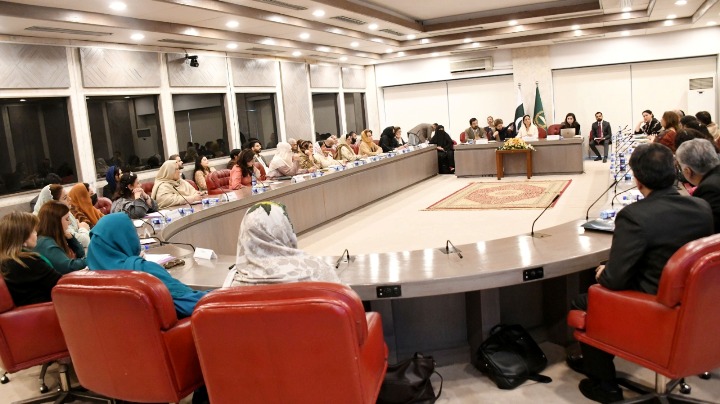
Women’s Parliamentary Caucus Launches Dialogue Series to Strengthen Parliamentary Quota System
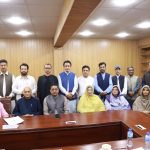
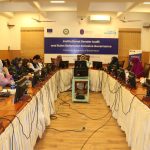
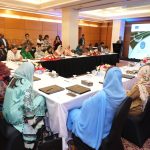
Islamabad, February 12, 2026; On the occasion of National Women’s Day 2026, the Women’s Parliamentary Caucus (WPC) of the National Assembly, under the convenorship of its Secretary, Dr. Shahida Rehmani, MNA, and in collaboration with UN Women, launched the first in a series of dialogues at Parliament House aimed at strengthening the parliamentary quota system to ensure equitable and meaningful representation of women in Parliament as well as Provincial and Legislative Assemblies across Pakistan.

In her opening remarks, Dr. Shahida Rehmani emphasized that the quota system is a structural measure intended to secure permanent and effective inclusion of women, with the ultimate objective of achieving at least 33% representation in legislative bodies, in line with women constituting half of Pakistan’s population. She underscored the importance of integrating women into mainstream legislative processes and enhancing their meaningful participation in parliamentary business, including Question Hour, Points of Order, and Calling Attention Notices—areas where women lawmakers are already demonstrating strong engagement relative to their numerical strength.
She also raised concerns regarding unequal treatment of women elected on reserved seats, particularly in access to development funds and intra-party opportunities, despite their active involvement in election campaigns and constituency outreach. The discussion highlighted serious gaps in the implementation of the mandated 5% general seat allocation for women, reiterating that the original demand had been significantly higher to ensure genuine and substantive political inclusion. She informed participants that the dialogue series will culminate in a major session in March, bringing together political leadership to deliberate on concrete measures for enhancing women’s representation in key decision-making positions.
The dialogue witnessed active participation from women parliamentarians, as well as provincial and legislative lawmakers, including virtual participation from WPC members representing Sindh, Balochistan, and Khyber Pakhtunkhwa. Representatives of the UN Women and PILDAT, Mr. Shabbir and Constitutional Expert, Mr. Zafarullah Khan also briefed participants on constitutional, legal, and comparative perspectives regarding women’s political representation.
Convenor of the Parliamentary Taskforce on SDGs, Ms. Shaista Pervaiz, highlighted that lack of financial resources remains a critical barrier for women candidates and emphasized that political parties must financially support their women nominees. MNA Ms. Farukh Khan stressed that women deliver exceptional results when provided opportunities and therefore must be given winnable constituencies along with financial assistance.
MNA, Ms. Huma Chughtai observed that the entrenched baradari system often restricts women without strong clan backing from contesting elections. She called for equitable representation of grassroots party workers and advocated reserving seats for aspiring women actively engaged in policy formulation and legislation. She also urged male colleagues to extend constructive support to women candidates. Citing a FAFEN report, it was noted that women legislators often demonstrate stronger engagement in legislative proceedings, and she emphasized full and effective implementation of reserved seats.
MNA, Ms. Nuzhat Sadiq, First Treasurer of the WPC, observed that women entering politics through limited pathways are frequently labelled as “token” representatives, undermining their legitimacy. She called for a shift from symbolic inclusion to substantive empowerment and cited the example of the United States, where women candidates receive financial support, suggesting similar mechanisms could be explored in Pakistan.
Deputy Speaker of the Provincial Assembly of Khyber Pakhtunkhwa, Ms. Suriya Bibi, shared that 36% of women voters supported her in her constituency and stressed the need for women’s representation in core party decision-making bodies to increase the 5% ticket quota to a more equitable level.
MNA, Ms. Naeema Kishwer Khan emphasized collective advocacy by national and provincial caucuses to increase women’s representation beyond 5%, alongside strict enforcement of existing quotas.
MNA Shahida Begum, Treasurer of the WPC, highlighted women’s consistent commitment in public service, sharing her experience of establishing a women’s wing within her party through persistent efforts. She underscored that women’s empowerment transcends party lines and expressed optimism that strengthened legislation would be effectively implemented over time.